 JOHN FINLAY MINING 中文JOHN FINLAY MINING 中文
June 2026, 500 kg from a lead-zinc mining company in Fujian (chalcopyrite, galena, sphalerite): one density cut enriched both metals simultaneously.
| Product | Yield % | Pb % | Pb rec. % | Zn % | Zn rec. % |
|---|---|---|---|---|---|
| Concentrate | 54.95 | 0.950 | 98.30 | 6.500 | 98.39 |
| Rejects | 45.05 | 0.020 | 1.70 | 0.130 | 1.61 |
| Feed | 100.00 | 0.531 | 100.00 | 3.630 | 100.00 |
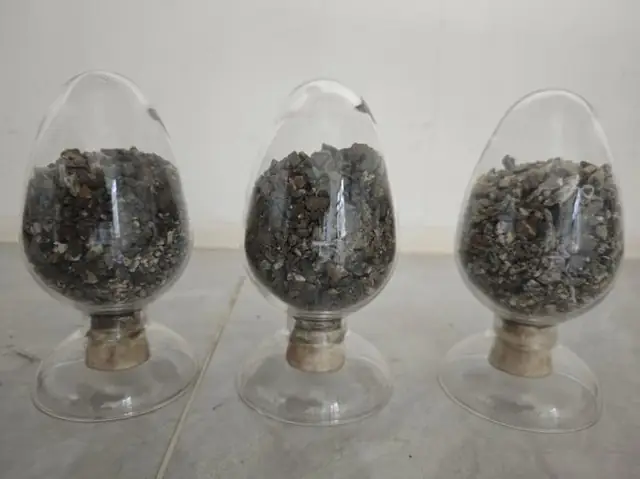
Galena (7.5 g/cm³) and sphalerite (4.0) both sit far above the gangue — a single dense-medium cut concentrates both, and the polymetallic pre-concentrate feeds a smaller, cheaper differential flotation circuit.
The Fujian sample carries three sulphides — chalcopyrite, galena, sphalerite — in a quartz-calcite host. Polymetallic ores usually mean complex differential flotation from the first tonne. The pre-concentration question: can one density cut carry all payable metals forward together, leaving the complexity for a smaller downstream plant?
It can. One cut at 54.95% yield enriched lead 1.79× (0.531% → 0.950%) and zinc 1.79× (3.630% → 6.500%) simultaneously, with recoveries of 98.30% and 98.39% — the highest in our portfolio. The 45.05% rejected carries just 1.70% of the lead and 1.61% of the zinc. Both sulphides sit far above the gangue in density (galena 7.5, sphalerite 4.0 vs ≈2.7), so they travel together to the underflow; separation of Pb from Zn is deferred to differential flotation, now sized for 55% of the original tonnage.
| Item | Value |
|---|---|
| Feed size fraction | 0.5–10mm |
| Separator | Pressurized two-product dense medium cyclone |
| Medium | Ferrosilicon + magnetite powder, closed-circuit recovery |
| Density control | In-line density gauge with automatic water/medium make-up loop |
| Value mineral density | Galena, sphalerite: 3.9–7.6 g/cm³ |
| Gangue density | Quartz, calcite: 2.65–2.71 g/cm³ |
| Process water | 0.1 m³/t, fully recirculated |
| Medium drainage | Sieve bends + drain-and-rinse screens |
The ore was first wet-screened to remove the −0.5 mm slimes (evaluated separately for flotation). The 0.5–10mm fraction was fed to a ferrosilicon/magnetite suspension; a density-gradient series located the optimum cut density, after which the sample was passed once through a pressurized two-product cyclone. Products were drained on sieve bends, rinsed on drain-and-rinse screens, dewatered, sampled and assayed to compute yield, grade and recovery. Dilute medium was recovered by magnetic separation and densified back to the correct-medium sump under closed-loop density control.
For polymetallic mines the pre-concentrate model reorders the flowsheet economics: the costly selective-flotation stage — reagent schemes, conditioning, multiple cleaner circuits — shrinks by nearly half, while total metal loss ahead of it stays under 2%. The same logic extends to any Pb-Zn-Cu-Ag assemblage with a dense sulphide suite.
Q: What recovery did dense medium separation achieve on this lead-zinc ore?
A: Pb recovery 98.30% and Zn recovery 98.39% in one density cut, with 45.05% of mass rejected (0.5–10 mm).
Q: Will this work on my lead-zinc deposit?
A: Density separation depends on liberation size and density contrast, not on locality. A one-tonne representative sample answers the question definitively — a test plan within 48 hours of sample receipt.
Send ~1 tonne of representative ore — a test plan within 48 hours of sample receipt.
Contact us