 JOHN FINLAY MINING 中文JOHN FINLAY MINING 中文
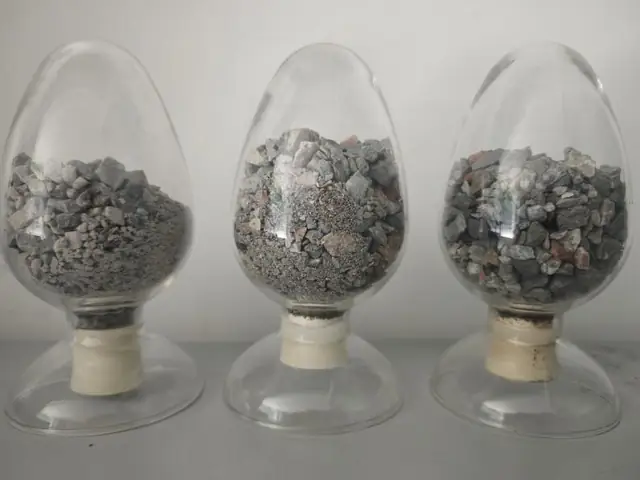
September 2025: five low-grade phosphate ores from a Guizhou tailings pile, 0.5–10 mm. The best sample became a commercial-grade concentrate — the pile is worth re-mining.
| Product | Yield % | Grade % | Recovery % |
|---|---|---|---|
| Concentrate | 43.81 | 32.89 | 79.68 |
| Rejects | 56.19 | 6.54 | 20.32 |
| Feed | 100.00 | 18.08 | 100.00 |
Tailings piles and waste dumps are dormant assets. Where grades like these persist, dense-medium re-processing recovers value that was already mined and paid for — while shrinking storage liability and environmental risk.
The "deposit" here is man-made: a Guizhou tailings pile accumulated from decades of phosphate processing, sampled as five distinct low-grade ores between roughly 12% and 18% P₂O₅. Legacy piles like this carry zero mining cost, sit next to existing infrastructure, and are already broken — the crushing bill was largely paid decades ago. What they lack is a separation step that pays.
Across the five samples, selectivity and stability varied — which is exactly what re-mining feasibility must map. The best ore returned an enrichment ratio of 1.82 (18.08% → 32.89% P₂O₅) at 79.68% recovery, with final tailings depressed to 6.54% — below any re-processing interest, i.e. genuinely spent. The 32.89% concentrate is premium commercial grade; the campaign therefore brackets the pile's value between its best and worst zones rather than quoting a single optimistic number.
| Item | Value |
|---|---|
| Feed size fraction | 0.5–10mm |
| Separator | Pressurized two-product dense medium cyclone |
| Medium | Ferrosilicon + magnetite powder, closed-circuit recovery |
| Density control | In-line density gauge with automatic water/medium make-up loop |
| Value mineral density | Collophane: 3.0–3.2 g/cm³ |
| Gangue density | Quartz, dolomite: 2.65–2.87 g/cm³ |
| Process water | 0.1 m³/t, fully recirculated |
| Medium drainage | Sieve bends + drain-and-rinse screens |
The ore was first wet-screened to remove the −0.5 mm slimes (evaluated separately for flotation). The 0.5–10mm fraction was fed to a ferrosilicon/magnetite suspension; a density-gradient series located the optimum cut density, after which the sample was passed once through a pressurized two-product cyclone. Products were drained on sieve bends, rinsed on drain-and-rinse screens, dewatered, sampled and assayed to compute yield, grade and recovery. Dilute medium was recovered by magnetic separation and densified back to the correct-medium sump under closed-loop density control.
This is the proof-case for our second pillar: the same density flowsheet that pre-concentrates run-of-mine ore also re-mines legacy piles — with the spent rejects feeding aggregate and manufactured-sand production, shrinking the pile from both ends. Storage liability falls while a new revenue line opens.
Q: What recovery did dense medium separation achieve on this phosphate ore?
A: 79.68% P₂O₅ recovery into a 32.89% concentrate from an 18.08% tailings-pile feed (0.5–10 mm).
Q: Will this work on my phosphate deposit?
A: Density separation depends on liberation size and density contrast, not on locality. A one-tonne representative sample answers the question definitively — a test plan within 48 hours of sample receipt.
Send ~1 tonne of representative ore — a test plan within 48 hours of sample receipt.
Contact us