 JOHN FINLAY MINING 中文JOHN FINLAY MINING 中文
June 2026, 280 kg from Hunan Anhua the Hunan tungsten client: the fine fraction passing the XRT screen was upgraded by DMC — tailings ended 33%% below the contractual target.
| Product | Yield % | WO₃ % | Recovery % |
|---|---|---|---|
| Concentrate | 67.06 | 0.205 | 95.43 |
| Rejects | 32.94 | 0.020 | 4.57 |
| Feed | 100.00 | 0.144 | 100.00 |
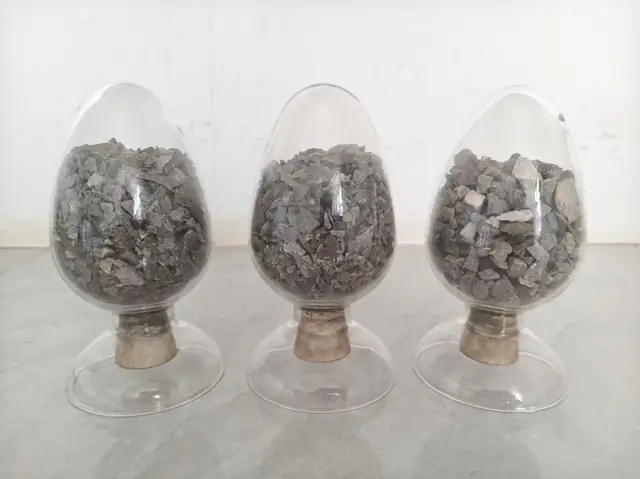
This is the two-stage architecture at work: XRT dry sorting handles the coarse fraction, dense medium cyclones catch the screen underflow — no size window escapes pre-concentration.
The client's operation already runs XRT dry sorting on the coarse fraction. The engineering question was the screen underflow: 0.5–10 mm fines at just 0.144% WO₃, too fine for XRT and too lean to justify full processing. The contractual bar was explicit — reject waste to a tailings grade of ≤0.030% WO₃ or the fines route fails.
The cut rejected 32.94% of the fines at 0.020% WO₃ — beating the contractual ceiling by a third — while holding recovery at 95.43%. With wolframite and scheelite at 5.9–7.5 g/cm³ against 2.6–2.9 gangue, the density contrast is the largest of any case in our portfolio, which is why so sharp a rejection is achievable at so little metal loss (4.57%). The 0.205% WO₃ pre-concentrate then justifies the fine-gravity/flotation finish that follows.
| Item | Value |
|---|---|
| Feed size fraction | 0.5–10mm |
| Separator | Pressurized two-product dense medium cyclone |
| Medium | Ferrosilicon + magnetite powder, closed-circuit recovery |
| Density control | In-line density gauge with automatic water/medium make-up loop |
| Value mineral density | Wolframite / scheelite: 5.9–7.5 g/cm³ |
| Gangue density | Quartz, mica: 2.6–2.9 g/cm³ |
| Process water | 0.1 m³/t, fully recirculated |
| Medium drainage | Sieve bends + drain-and-rinse screens |
The sample was the screen underflow from a preceding XRT dry-sorting stage. The ore was first wet-screened to remove the −0.5 mm slimes (evaluated separately for flotation). The 0.5–10mm fraction was fed to a ferrosilicon/magnetite suspension; a density-gradient series located the optimum cut density, after which the sample was passed once through a pressurized two-product cyclone. Products were drained on sieve bends, rinsed on drain-and-rinse screens, dewatered, sampled and assayed to compute yield, grade and recovery. Dilute medium was recovered by magnetic separation and densified back to the correct-medium sump under closed-loop density control.
This campaign is the working demonstration of the two-stage coverage we design toward: XRT takes 60–10 mm dry, DMC catches the 10–0.5 mm underflow, and no size window escapes pre-concentration. For tungsten operators the payoff compounds — tungsten's price makes every recovered kilogram count, while the rejected third of the fines never touches the expensive fine-gravity circuit.
Q: What recovery did dense medium separation achieve on this tungsten ore?
A: 95.43% WO₃ recovery with 32.94% of mass rejected at a 0.020% tailings grade (0.5–10 mm XRT screen underflow).
Q: Will this work on my tungsten deposit?
A: Density separation depends on liberation size and density contrast, not on locality. A one-tonne representative sample answers the question definitively — a test plan within 48 hours of sample receipt.
Send ~1 tonne of representative ore — a test plan within 48 hours of sample receipt.
Contact us